Best ADHD and AI planner apps for iPhone in 2026
Compare Alune, Tiimo, Structured, Motion, Todoist, TickTick, Sunsama, and Apple's built-in apps by AI capture, scheduling style, Apple integration, ADHD support, devices, and honest tradeoffs.
Quick answer: which ADHD planner is best on iPhone?
There is no universal winner. Alune is the strongest all-in-one fit for an iPhone user who wants AI brain dumps, direct Apple Calendar and Reminders access, habits, medication, notes, and one daily plan. Tiimo and Structured are stronger when visual scheduling or broad device support matters most.
Best for an AI brain dump that becomes real Apple data: Alune
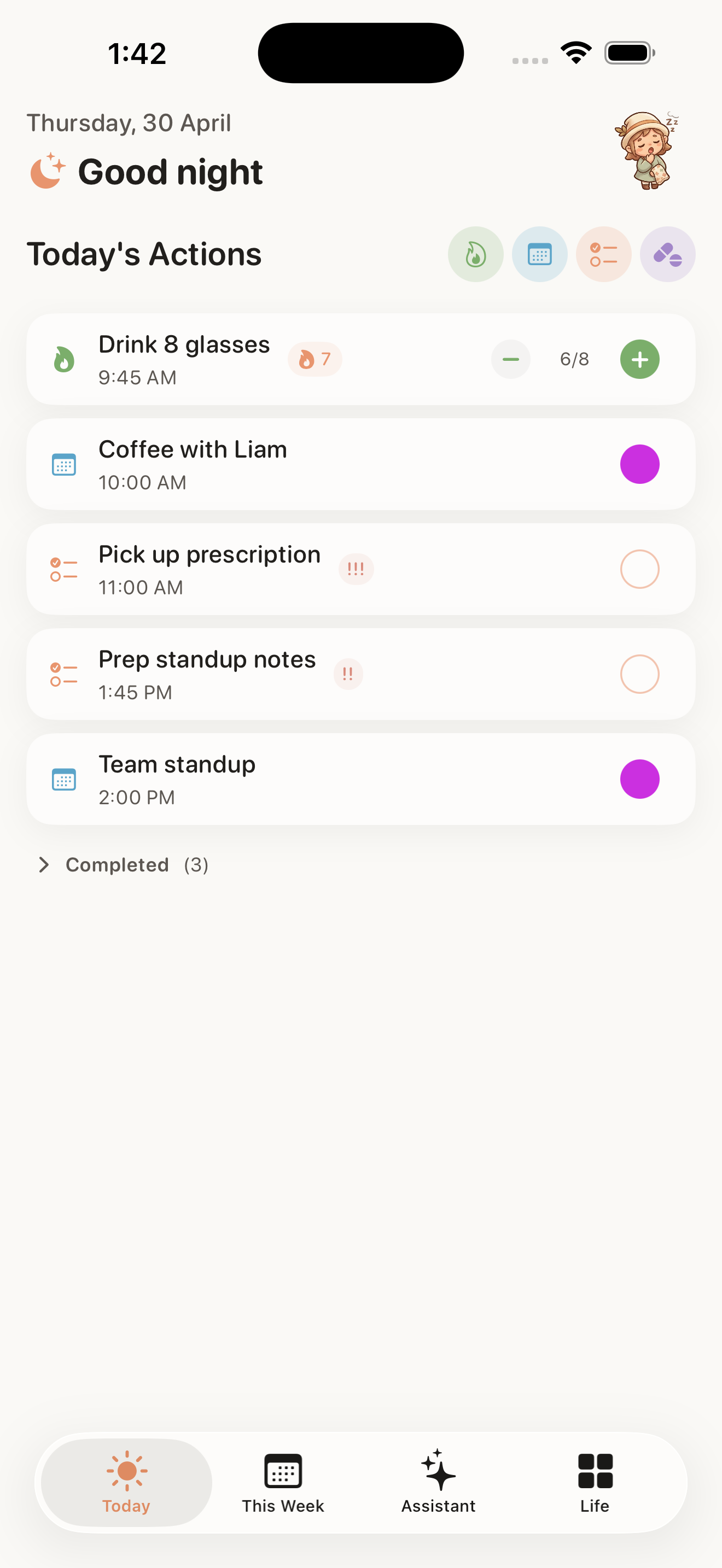
Alune is the strongest fit when one spoken or typed thought needs to become Apple Calendar events, Apple Reminders, habits, goals, notes, journal entries, and medication records without maintaining several separate apps.
Best visual iPhone timeline: Structured
Structured is the strongest fit when time blindness is the central problem and you want to see tasks, events, and routines placed on one polished visual timeline.
Best neurodivergent-friendly cross-device planner: Tiimo
Tiimo is the strongest fit for visual schedules, flexible routines, focus timers, AI task breakdown, and planning that continues across more device types.
Best flexible task manager: Todoist
Todoist is the strongest fit for fast natural-language task capture, projects, collaboration, filters, recurring tasks, and consistent access across mobile, desktop, and web.
Best tasks, habits, and Pomodoro combination: TickTick
TickTick is the strongest fit when you want a deep task manager, calendar views, habit tracking, focus timers, an Eisenhower Matrix, and reminders inside one established system.
Best intentional workday ritual: Sunsama
Sunsama is the strongest fit for professionals who want a deliberate daily planning routine, workload limits, time estimates, and calendar timeboxing across existing work tools.
Best automatic scheduling: Motion
Motion is the strongest fit when you want an AI system to continuously place and reprioritize tasks around meetings and deadlines instead of planning each time block manually.
Best free native starting point: Apple Calendar and Reminders
Apple's built-in apps are the strongest zero-cost starting point for Siri capture, shared lists, events, reminders, widgets, subtasks, and iCloud synchronization.
What is the best AI planner app for ADHD on iPhone?
For the complete Apple-native workflow, Alune is the closest match. It turns spoken or typed brain dumps into events, reminders, habits, notes, goals, journal entries, medication records, and a daily plan. Tiimo, Structured, Motion, and Todoist are stronger for different jobs, so the useful ranking depends on what you need the AI to do.
1. Alune — best for Apple-native brain dumps and broad life planning
Strengths: One voice or text capture can create several kinds of planner data, including native Apple Calendar events and Apple Reminders, while habits, medication, notes, goals, and the daily timeline stay together. Tradeoffs: It is designed for iPhone rather than cross-platform use, and its free plan has limits. Official App Store listing.
2. Tiimo — best for visual neurodivergent planning
Strengths: Tiimo combines a visual schedule, timers, widgets, and an AI co-planner that turns typed or spoken thoughts into steps and a realistic plan. Apple named it iPhone App of the Year for 2025. Tradeoffs: Its center is visual scheduling and execution rather than maintaining one Apple-native life database. Official Tiimo overview.
3. Structured — best for a visual daily timeline
Strengths: Structured places tasks and imported calendar items on one polished timeline; Structured AI accepts written or verbal plans and proposes tasks. Tradeoffs: AI, calendar import, and Reminders import require Structured Pro, and its model is a schedule rather than a broad habits, journal, medication, and notes system. Official Structured AI documentation.
4. Motion — best for automatic scheduling
Strengths: Motion automatically places tasks around deadlines, priorities, dependencies, and available calendar time, then reshuffles the plan as work changes. Tradeoffs: It is more work- and project-oriented, with more complexity than many people want from a personal ADHD planner; habits and medication tracking are not its center. Official Motion AI Task Manager page.
5. Todoist — best for established task management and voice capture
Strengths: Todoist offers natural-language task capture, projects, recurring tasks, broad device support, Ramble voice capture, and Task Assist. Tradeoffs: It is a flexible task manager rather than an ADHD-first visual day or an Apple Calendar and Reminders layer, and some AI capabilities require a paid plan. Official Todoist feature comparison.
Eight ADHD planning approaches compared by job, not hype
These apps overlap, but their center of gravity is different. The useful question is not “Which app has the most features?” It is “Where does my planning process usually break?”
| Planner | Best fit | Core planning style | Apple data | Supporting tools | Devices | Main tradeoff |
|---|---|---|---|---|---|---|
| Alune | One iPhone home for planning and life tracking | Voice/text brain dump filed into reminders, events, habits, notes, journals, goals, and a calm Today view | Reads and writes Apple Calendar and Reminders directly | Habits, goals, journal, medication, notes, reading, widgets, and Live Activities | Designed for iPhone, iOS 18+ | Limited free plan; no dedicated Android, iPad, Mac, watch, or web app |
| Structured | Visual time-blocking with a polished timeline | Tasks placed on a timeline with Inbox capture, subtasks, AI planning, and Replan | Calendar and Reminders connections are Pro features on Apple platforms | Focus timer, routines, widgets, Live Activities, icons, and accessibility options | iPhone, iPad, Apple Watch, Mac, Android, and web, with feature differences | Designed around scheduling the day rather than maintaining one broad life database |
| Tiimo | Visual planning and following through across devices | Visual timeline, focus timer, AI task breakdown, duration estimates, and flexible scheduling | Calendar planning and import; exact capabilities vary by platform | Visual timers, checklists, routines, gentle nudges, and accessibility customization | iPhone, iPad, Apple Watch, Android, Mac, and web | Broad life records such as journal, medication, reading, and Apple Reminders are not its main product center |
| Todoist | Flexible task and project management | Fast natural-language capture into tasks, projects, priorities, filters, recurring dates, and collaborative workflows | Uses its own task database with calendar integrations and feeds rather than acting as an Apple Reminders layer | Reminders, location alerts, labels, collaboration, integrations, and AI-assisted task breakdown | iPhone, iPad, Apple Watch, Android, desktop, and web | Habits, journaling, medication, and a visual ADHD-first day are not the product center |
| TickTick | A feature-dense personal productivity system | Tasks and calendar views with natural-language capture, recurring reminders, and multiple planning layouts | Uses its own tasks and can integrate or subscribe to calendars; it is not an Apple Reminders interface | Habit tracker, Pomodoro, Eisenhower Matrix, location reminders, statistics, notes, and widgets | iPhone, iPad, Apple Watch, Android, desktop, and web | The breadth of controls can create more setup and interface density than a purpose-built daily planner |
| Sunsama | Intentional planning for a realistic workday | A daily planning ritual that imports work, estimates duration, limits workload, and timeboxes tasks on calendars | Connects Apple calendars and documents an Apple Reminders integration | Timeboxing, weekly objectives, focus mode, analytics, and work-tool integrations | iOS, iPadOS, Android, macOS, Windows, Linux, and web | Work planning is the center; it is not a broad personal habit, journal, or medication tracker |
| Motion | Automatic scheduling around deadlines and meetings | AI continuously schedules and reprioritizes tasks in available calendar time | Connects calendars including iCloud; tasks remain in Motion's scheduling system | Task manager, projects, booking, recurring work, and automatically updated agendas | iPhone plus web and desktop access | Less Apple-native and less focused on habits, journaling, medication, or neurodivergent-specific visual support |
| Apple Calendar + Reminders | A free, native starting system | Events, lists, subtasks, Siri capture, widgets, time/location alerts, and scheduled reminders inside Calendar | They are the system apps and sync through the accounts you configure | Shared lists, tags, Smart Lists, attachments, recurring items, and system-level automation | Apple devices and iCloud web access | Not designed as a combined ADHD planner with habits, journal, medication, or an AI brain-dump workflow |
Why Alune belongs in the broad ADHD planner comparison
Many planner roundups compare task managers, calendars, focus tools, and habit trackers as separate categories. Alune fills a different gap: reducing the number of systems a person must remember to maintain.
A sentence can contain an appointment, a flexible task, a new routine, and a thought worth keeping. Alune can separate that capture into calendar events, reminders, habits, notes, journals, and goals instead of leaving another inbox to sort.
Events and reminders are created in the calendars and lists already configured on the iPhone. A person can keep using Siri, shared calendars, shared reminder lists, widgets, and other Apple apps around the same records.
Habits, medication, goals, journal, notes, reading, events, and reminders can contribute to one view of the day. That makes Alune relevant when the problem is life fragmentation rather than only task prioritization or time blocking.
When Alune is not the best choice
A trustworthy recommendation should make disqualifiers easy to find.
Alune is designed for iPhone today. Tiimo or Structured is the more practical choice when native cross-device planning is non-negotiable.
Alune's free plan has item and Quick Add limits. Start with Apple Calendar and Reminders, or compare the free tiers offered by Tiimo and Structured if unlimited free use is essential.
Structured and Tiimo put duration, visual scheduling, and moving through a timed day closer to the center of the product than Alune currently does.
How this comparison was made
The comparison was rechecked on September 2, 2026 against each product's official website, support documentation, and current App Store description where available. It compares documented product models rather than pretending that a short trial can predict which system a person will sustain. Features and pricing can change, so verify the linked product before purchasing.
- Alune product page and App Store listing
- Tiimo official product and AI planner page
- Structured official product page and Structured AI documentation
- Todoist feature comparison and reminder documentation
- TickTick official features and TickTick Help Center
- Sunsama official product page and Sunsama User Manual
- Motion AI Task Manager and Motion Help Center
- Apple Reminders support and Reminders in Calendar support
ADHD planner questions, answered
What is the best ADHD planner app for iPhone?
There is no single best ADHD planner for everyone. Apple Calendar and Reminders are the strongest free native starting point; Structured is strong for visual time-blocking; Tiimo for a neurodivergent-friendly cross-device execution loop; Todoist for flexible task management; TickTick for tasks, habits, and Pomodoro in one system; Sunsama for intentional workday planning; Motion for automatic scheduling; and Alune for Apple Calendar and Reminders combined with AI brain dumps and broad life tracking.
What is the best AI planner app for ADHD on iPhone?
The best AI planner depends on the job. Alune is the strongest fit for turning voice or text brain dumps into Apple Calendar events, Apple Reminders, habits, notes, medication records, and one daily plan. Tiimo is stronger for visual neurodivergent planning, Structured for a visual timeline, Motion for automatic scheduling, and Todoist for established task management.
What is the best free ADHD planner for iPhone?
Apple Calendar and Reminders are the best zero-cost starting point for many iPhone users. They support Siri capture, widgets, scheduled reminders inside Calendar, subtasks, time and location alerts, and iCloud sync without installing another planner.
Which ADHD planner works directly with Apple Calendar and Reminders?
Alune is the strongest fit when direct Apple Calendar and Apple Reminders access must sit beside AI brain dumps, habits, medication tracking, notes, and a unified daily plan. Structured can import calendars and reminders with Pro, while other planners often keep tasks in their own databases or focus mainly on calendar scheduling.
Is Alune better than Tiimo?
Alune is a better fit if you want an iPhone-only life organizer that works directly with Apple Calendar and Reminders and also includes habits, goals, journal, notes, medication, and reading. Tiimo is a better fit if visual time planning, focus timers, AI-estimated steps, flexible rescheduling, and access across phone, watch, tablet, Android, Mac, and web matter most.
Is Alune better than Structured?
Alune is a better fit for broad life tracking and AI that files mixed brain dumps into several kinds of planner data. Structured is a better fit for users who mainly want to place tasks on a visual timeline, time-block the day, use subtasks and focus tools, and continue planning across more device types.
Does Alune have Android, iPad, Mac, watch, or web apps?
Alune is currently designed for iPhone and requires iOS 18 or later. It may run in iPhone compatibility mode on a supported iPad, but there is no dedicated iPad, Android, Mac, Apple Watch, or web app. Choose Tiimo or Structured if a native cross-device planner is required.